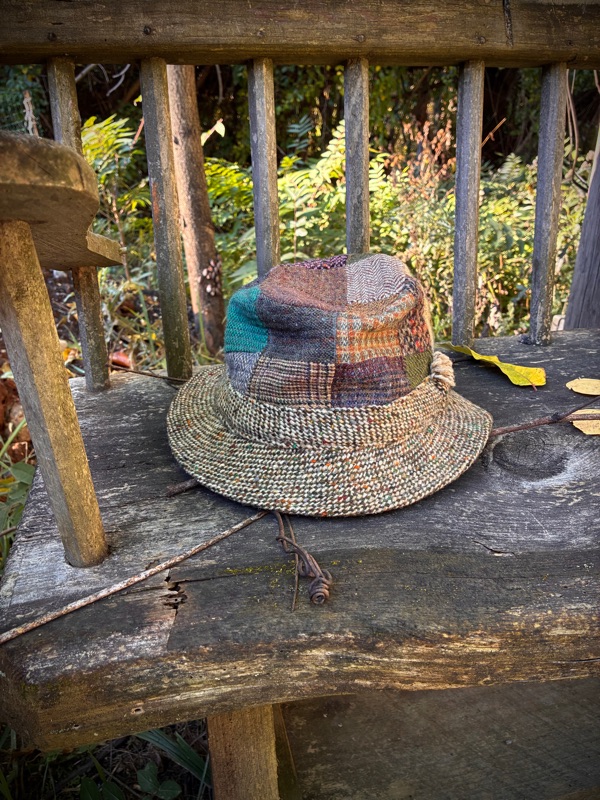
In 1921, sixteen-year-old David Hanna cycled a hundred miles from Belfast to Donegal Town for a tailoring job at McDaid’s. The owner died a year later with no heir, so at nineteen David took over. Hanna Hats was born in 1924.
Forty years of bespoke suits, then a local man asked for a hat. David made a short-brimmed trilby from Donegal tweed in four and a half hours and called it number eighty-four, after the shop’s phone number. Spares went in the window so the cloth wouldn’t go to waste. An American with ties to L.L. Bean bought them, and that connection opened the American market.
His sons joined in the sixties. John took over in the eighties, renamed it Hanna Hats of Donegal, and passed in May 2019. Today his grandchildren Eleanor and John Patrick run the same workshop on Tirconaill Street with the same scissors. At their peak the workshop was turning out over two thousand caps a week for the US alone, boosted by Peaky Blinders and a wall of fame that includes Patrick Dempsey.
Eleanor says many hats get passed down through families. That’s not marketing. That’s the product.
In 2013, Terry Kast filmed John showing his little hat museum. One cap from 1967, made for a young man starting at a bank, a fisherman. The brim warped from fifty years of wear. Before he died, the customer came in and said, “Johnny, I want you to have that hat.” When the man passed, John returned it to his wife. It sat on the coffin. She gave it back the next day.
Sit with that for a moment. A man wears a hat for fifty years. Because it fits his head, his weather, his life. The wool cloth of which it’s made remembers his hands. The brim remembers the rain. When he dies, his family doesn’t reach for a photograph. They reach for the hat. Because the hat is him — the shape of his head still in it, the years still in it. And then they give it back to the man who made it, because they understand something most people have forgotten: an object made with care doesn’t belong to you. It belongs to the story.
You don’t put a fifty-year-old baseball cap on a coffin. You put a Hanna hat there because it was the man, and the man was still in it.
A hat like this isn’t an accessory. It’s a record. Of where you’ve been, what you’ve done, who you are when nobody’s watching. A man wears it to fish, to stand in a field at dusk, to walk into the woods alone. It takes the shape of his life the way a river takes the shape of its bed. It only happens one day at a time, over decades, with a hat that refuses to quit.
Someone wears this because they’ve decided some things deserve to last. They’ve felt the difference between scissors and a machine, and it matters more than convenience. They’re not going back in time. They’re carrying something forward the present keeps dropping.
Their grandfather might have worn one. Their father didn’t. The hat says that world isn’t gone.
If you’ve ever held something your father held, you know. The things we keep are the things that keep us.
Stay safe, Bob
This article was researched and written using modern research techniques.
Sources
- Hanna Hats of Donegal — official heritage page: https://hannahats.com/pages/heritage
- Irish Central — “How a bike ride led to the 100 year legacy of Hanna Hats”: https://www.irishcentral.com/irish-shopping/buy-irish/legacy-hanna-hats
- Business Post — “Hanna Hats of Donegal plots European and Asian expansion”: https://www.businesspost.ie/companies/hanna-hats-of-donegal-plots-european-and-asian-expansion/
- Terry Kast — “John Hanna on first and last caps” (April 2013): https://www.youtube.com/watch?v=TBD
- Donegal Daily — “Business booms as Donegal company tips its hats to Peaky Blinders”: https://www.donegaldaily.com/news/business-booms-as-donegal-company-tips-its-hats-to-peaky-blinders-337665
- The Irish Times — “The Irish hats loved by Brad Pitt, Matt Damon and Britney Spears”: https://www.irishtimes.com/life-and-style/Fashion/the-irish-hats-loved-by-brad-pitt-matt-damon-and-britney-spears-1.4791906
- Donegal Daily — “Hats off to Hanna as Donegal brand lands US Today Show slot”: https://www.donegaldaily.com/news/hats-off-to-hanna-as-donegal-brand-lands-us-today-show-slot-654375
- Donegal Live — “We’ll miss you so much — Hanna Hats wish Tony Gallagher the best after 46 years”: https://www.donegallive.ie/news/business/1971612/we-ll-miss-you-so-much-hanna-hats-wish-tony-gallagher-the-best-after-46-years.html
- Ireland’s Eye Magazine — “Hanna Hats: A tradition dating back to 1924”: https://irelandseye.ie/hanna-hats

