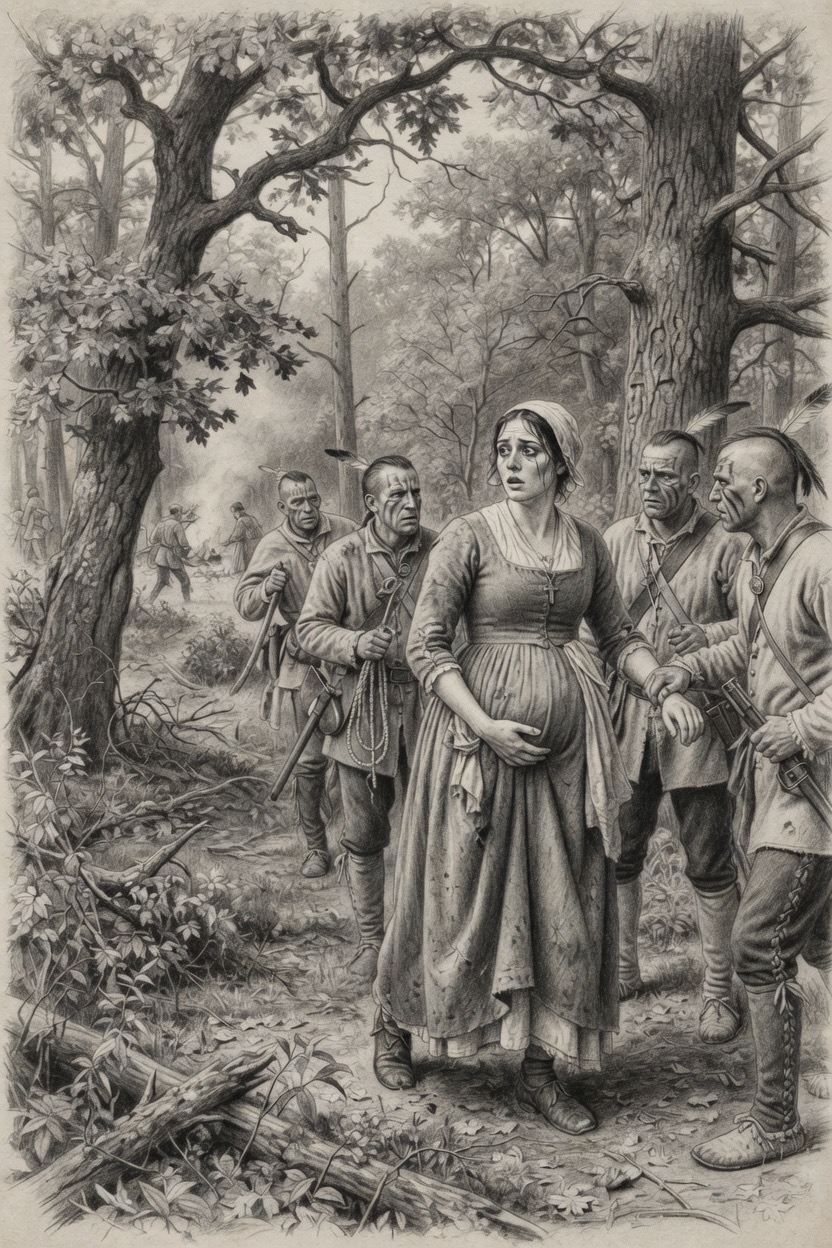
Most people only know about the schoolhouse.
They don’t know that the same four Lenape warriors struck the day before, July 25, 1764, in Peters Township near Bridgeport.
Susan King Cunningham was born about 1735, in what was then Cumberland County, Pennsylvania — which later became Franklin County. She was the daughter of Robert King, a Scotch-Irish settler. By the 1750s, Susan’s family had pushed west into the frontier of Peters Township. Around 1757, she married Hugh Cunningham. They settled on a homestead near the small settlement of Bridgeport, later known as Marks. Their home stood close to McDowell’s Mill and its stockaded fort. She was 29 years old and pregnant with another child.
On that July day she was walking through the woods to visit a neighbor when the warriors caught her. They beat her to death and scalped her. The warriors then cut the unborn child from her body and laid the infant on the ground beside her. That’s exactly how her family found her.
The very next morning those same warriors walked into Enoch Brown’s classroom. They killed the teacher and ten children, scalping every one of them. Only one boy lived.
These two killings — a pregnant mother and a classroom of kids — tore through the Conococheague Valley. Eight months later, that same fear and rage fueled the Black Boys Rebellion, when men from these hills painted their faces black, burned supply wagons, and twice attacked Fort Loudoun.
Susan has no grave marker. No plaque. No park. Nothing. Just a few forgotten lines in dusty books.
But out here, we remember the ones the history books left behind — because those are the stories that show how hard this land really was.
This is the kind of history we walk past every day out here in the backcountry, quiet ground that still remembers.
Sacred ground
 |


1 comment:
Sub notes
Birth and Early Life
• Born: About 1735 in what was then Cumberland County, Pennsylvania Colony (the area later became Franklin County in 1784).
• This places her birth right in the heart of the early Scotch-Irish settlements in the Cumberland Valley / Conococheague region.
Parents and Family Origins
• Father: Robert King (born about 1705 in Ulster, Ireland; died 1763 in Pennsylvania). He was a Scotch-Irish immigrant who arrived in Pennsylvania around 1717 and settled initially in the Lancaster County area.
• Mother: Records vary slightly. Most sources list her simply as Robert King’s first wife (name unknown). One detailed family tree names her Ann McLaughlin, but the timeline suggests Ann may have been a later wife (Robert remarried around 1736). Susan was likely from Robert’s first marriage.
• Robert King’s will (probated in Lancaster County) and several DAR-submitted family Bibles and genealogies confirm the family connection.
How the Family Ended Up in the Settlements
• The Kings were typical early Scotch-Irish pioneers pushing westward from older settlements in Lancaster County.
• Susan (then a young married woman) came to the Peters Township / Bridgeport (later called Marks) area from Little Britain Township, Lancaster County. This is explicitly noted in the 1916 Fort McDowell monument dedication address, which also records that she was the sister of the Rev. John King, D.D., a well-known Presbyterian minister who later pastored the Church Hill Presbyterian Church in Mercersburg.
• By the 1750s the family had moved into the more exposed frontier lands along the Conococheague Creek, where land was cheaper and more available but raids were a constant threat. Susan married around 1757 and lived with her husband on a homestead near Bridgeport/Marks, close to McDowell’s Mill and Fort McDowell.
Marriage and Children
• Husband: Hugh Cunningham (some older sources list him as John; the Hugh spelling appears based on original deeds). They married about 1757 in Cumberland County.
• Children (born before her death): Elizabeth (1755–1828, who later married Archie McCullough, the schoolhouse massacre survivor), Robert, John, and Hugh (plus possibly others born shortly after her death or listed in extended trees).
These details come from solid but secondary sources:
• WikiTree and RootsWeb family trees compiled from original wills, deeds, and church records.
• Local histories such as C. Hale Sipe’s The Indian Wars of Pennsylvania and Thomas Creigh’s history of the Mercersburg Presbyterian Church.
• The 1916 Fort McDowell dedication pamphlet, which draws on contemporary accounts and Dr. John King’s own diary.
Susan’s story is typical of many backcountry families: Scotch-Irish immigrants’ children who were born on the frontier, moved farther west as the settlements expanded, and lived with the daily risks that came with it. There’s no grand “arrival in America” tale for her personally — she was already here, part of the second wave that turned wilderness into farmsteads.
Post a Comment